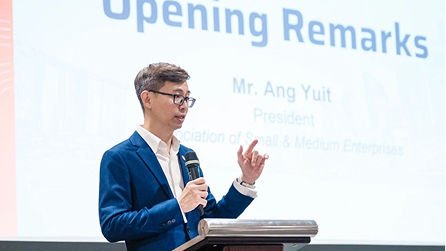


Keynote Address by Mr Ang Yuit, President, at Bilingual Fireside Chat: The Middle East Issue and Its Impact on Businesses on 8 June 2026
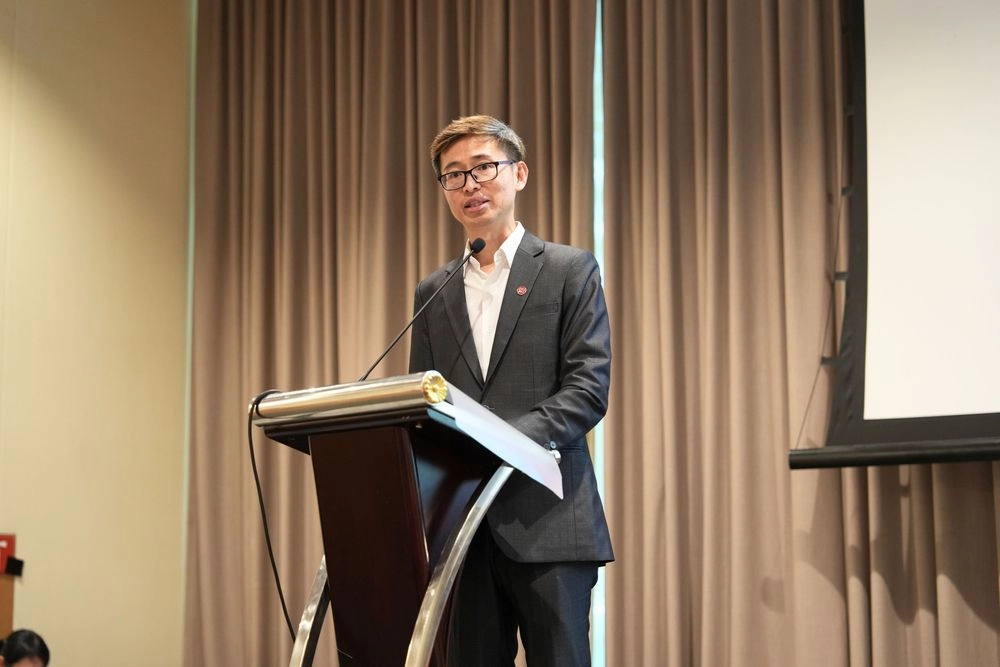
Good afternoon, a very warm welcome to our seminar on the Middle East and Its Impact on Businesses. Personally, I’ve had a lot of weekends discussing with media about all the different challenges that our businesses have been facing, from oil trade to material prices going up to logistics challenges, and all of that is how we’ll be doing our best to ensure that the government is very well aware of all the challenges that we are dealing with on a recovery basis.
So today, what we’re trying to do is really put it together and talk about redesigning the supply chains and procurement in a highly competitive era, and then after this, we’ll have a chat with Ms Sim Ann, the Senior Minister of State for Ministry of Home Affairs and Ministry of Foreign Affairs. I think on the foreign affairs side, it would be quite interesting if you all have some questions around how our government is dealing with this very dynamic situation with balancing geopolitics.
Let me start by acknowledging our current business landscape which is rather unforgiving right now. It’s very challenging for all of us. We are navigating a very severe disruption in global energy and maritime transit with the recent escalation in the northeast. So critical maritime corridors like the Straits of Hormuz are essentially blockaded, and these corridors handle a massive percentage of the world’s sea-borne oil trade, and shock waves are gradually leading towards our shores, as we all know. In the meantime, of course, I think countries like Iraq, Dubai, Vietnam, and Saudi Arabia are trying to construct a land corridor out of Hormuz and bypass Hormuz, but I think that will take a while. So for now, we are really very much stuck.
For Singapore businesses, this is a direct and measurable hit for supply chains, energy grids, and our bottom lines.
So today, we’ll break down from our perspective, what the pressure points are, and most importantly, what you can do to proactively respond and take back control.
To understand the local impact, we must first look at the global supply lines. The Middle East serves as the central artery for global energy shipments. So as all we know, it’s not just energy, but a lot of material and substances that come down as a byproduct and tertiary product of oil. When a critical chokepoint like the Strait of Hormuz experiences hostilities or blockages, shipping companies are forced to halt operations or reroute their vessels. We are seeing a new reality where maritime transit takes significantly longer and costs are substantially more. And this impacts the cost of goods that are landing at our ports.
As a small and open economy, Singapore is highly sensitive to external shocks as well. Your suppliers are paying more for freight, your logistics partners are facing higher insurance premiums – so it’s not just oil, but insurance premiums are going up – and these costs are passed down to your business. In some cases, I have heard of companies taking advantage of this situation and also jacking up prices, so all this has a compounding effect that squeezes margins at every level of production and retail. And businesses are essentially paying more money to receive their goods, and the goods are coming in slower, so it’s compounded in both cases.
Now, the new reality of this is that the crisis underscores a vital counter-narrative regarding Singapore’s global standing. Because of the acute worldwide need for oil and energy, our refining infrastructure on the other hand, has gotten a boost, right? So Pulau Bukom has become an incredibly strategic tool. Our processing capacity for refined fuel has become critical for other countries’ economic resilience, such as Australia and New Zealand as well.
Australia imports 25% of their fuel from us. And in March, there was an agreement that was built between Singapore and Australia that we guaranteed supply of oil and petrol and diesel, particularly to Australia. And that made a big difference to them, because I was in Australia at the time, and farmers were thinking of shutting down operations, or moving out of it, or harvesting early and throwing away the rest, because they just couldn’t take on the increase in diesel prices. On the positive side, this has raised Singapore’s positive standing with Australians, because in recent years, our standing through telecom ownership with Optus has not been that great.
So with this, I think we’ve earned back some brownie points with Australia. This means that while we face severe domestic pressure, our role as a trusted and highly secure regional refining hub provides us with a unique economy of leverage and geopolitical importance during times of global disruption.
This means that while we face severe domestic pressures, our role as a trusted, highly secure regional refining hub provides us with unique economic leverage and geopolitical importance during times of global disruption.
Now let’s look at the data and see exactly where the pressure is highest. So, Singapore generates 95% of its electricity from imported natural gas. Because global gas prices are inextricably tied to oil, any tension in Middle Eastern shipping lanes triggers an automatic reaction here at home. So SP’s non-household electricity tariffs increased by 2%, and business electricity rates on the open market have seen hikes as well. And retailers have raised fixed-price plans by 10% to 23%.
It is natural therefore that in the recent SBF-IndSights Business Dipstick, a staggering 66% of businesses report energy prices as their most affected operational area.
When we drill down into what is strangling cash flow and working capital, we see the top two factors being, energy costs (58%) and logistics/freight costs (55%).
But the issues are not just financial costs. Operations have been severely affected as well, and 47% of businesses are experiencing longer shipping lead times, and a third are dealing with frequent delays in delivery and uncertainty.
We know how stressful it is to run a business when you cannot guarantee your inputs will arrive on time. You are forced to hold more buffers because of uncertainties, or risk having not enough supply. So that ties up even more of your working capital in that sense, because your cash is then stuck in warehouses or stuck in transit. So for many SMEs, this lack of liquidity is a pressing threat to survival.
While operating costs soar, we are facing a double whammy on the revenue front. When global costs rise, domestic inflation follows. Consumers get cautious, and they tighten their spending. So in today’s hiring climate, this is even more so.
Data shows that 56% of local SMEs are reporting revenue drops from their Singapore customers. The current trend shows that consumer spending has changed. Consumers are now highly value-conscious and are prioritising essentials like groceries, transport, and healthcare over discretionary dining and premium retail. And many of us know from our friends, family and relatives that many are also focusing their spending on travels overseas.
This drop in spending locally is further compounded when the RTS opens in 2027. I was just at the causeway, and you can see the RTS train going back and forth. They’re already testing it quite well. This new rail link will drastically cut travel time between Singapore and Johor, reduce the worries about traffic jams, and make cross-border shopping and dining much more accessible for the average Singaporean. And this will likely pull even more retail dollars out of our domestic market.
Some segments, though, are doing better than others. Consumers are shifting their spending to experiences, lifestyle and wellness services. So overall, the Singaporean consumer now demands a seamless omnichannel integration. They heavily research products and services before making a purchase, and they chase after what provides them with a high value to cost ratio.
Hence, instead of slashing your prices as a business and destroying your already-thin margins, you need to look at “value-stacking” your businesses. So think about re-bundling your existing products or services so they feel irresistible and high-value to a cautious shopper. Of course, we come from all industries and all sectors, so you must look at how that impacts you in your own area of work.
Now, we also have to acknowledge that this crisis does not hit everyone equally. And there’s clear divergence in the market that you can see, so there’s a High Risk vs Low Risk Zones.
Businesses in manufacturing, construction, logistics, and retail have been hard hit. These businesses rely heavily on physical supplies, shipping, and high energy usage. Temporary relief for energy intensive firms was a top request for 32% of businesses in a recent survey.
On the other hand, those providing digital services, consulting and other professional services currently face a lower comparative risk. The immediate impact of the choked-shipping routes and spike in energy prices are lessened as there is less reliance on physical goods and heavy electricity usage compared to those in manufacturing.
This divergence between high-risk and low-risk sectors further compounds the two-speed, K-shaped economy that we are observing in Singapore. So that’s something that I’ve been sharing with various policy political office holders and government civil servants, right? I say that even though most of us read the news, and we say that the GDP is going up by 3 to 4% and we did very well last year, I think a lot of it is put by a small segment of people and businesses, and the rest are not doing so well.
While Singapore is looking at a projected 2 to 4% growth right, many SMEs are not sharing the benefits of growth. Due to global and technological disruptions, the economy is moving at vastly different speeds depending on the sector that your business is in. This has led to a widening gap between high performing firms and those that are struggling.
On the upper arm of the K, we see that we have asset-light professional services, digital platforms, and high strategic energy infrastructure players that can adapt or find new regional relevance. On the downward arm, our traditional brick-and-mortar retailers, F&B operators, and logistics-dependent firms. They are pinched by escalating operational costs and compressed consumer wallets, making it a very hard pivot for themselves. Now, depending on where you sit in the K-shape economy and who your customers are and where they sit again dictates your immediate strategy, and you must look at it where it’s aggressively transforming or defensive capital preservation.
So I’ve seen a lot of companies that look at maintaining or keeping the cost manageable, just for the right time to seize the opportunity. So for some businesses, the term is called ‘keeping the powder dry’, so that’s what they’re doing now.
What are the practical steps forward? Businesses in the high risk zone need to monitor and manage their cash flows. And beyond increasing prices, look at renegotiating pricing and delivery terms with suppliers where possible, and even with your consumers and your customers. Take advantage of the government support in various cases, and you have to be very careful, because right now the government support is quite targeted, so depending on which sector you are in and which specific target grant that you’re looking at, talk to us, and we’ll be able to help you direct better. Essentially, there are certain grants that would help you in some areas, particularly if you’re hard hit by energy prices and energy shock. Also, look at working capital loans, and in some cases, where you are consuming electricity, the energy efficiency grants will help you change your equipment.
Now, I want to say one thing. If you are facing challenges, feel free to come to the association and give your feedback. Recently, we are talking to the government about energy efficiency grant 2.0 because the first one has come up, and the government is trying to hear what are the challenges and feedback from the first version of the grant, and if we have more feedback, we’ll give a directive to the government to carve out a more appropriate and a better support for us in the second version. So, long-term reduction in your utility bills will improve your operation markets. So, looking ahead, we must also look beyond just survival and cost management.
40% of our smaller businesses are conserving cash and delaying their investment and expansion. But eventually these conflicts will settle down, and when the Middle East stabilises, it will hold opportunities for Singapore businesses.
We know that 23% of smaller businesses are already using this time to switch or diversify their source markets. You can also apply the same mindset to future growth, and instead of writing off the Middle East, in this case, for example, use this gear to study the market and understand the market better. Keep in touch with potential partners and monitor which sectors are receiving investment there. By doing the research now, your business will be ready to enter the market when the conditions improve and consumer confidence returns.
With that, I wish everyone a fruitful seminar today. Do ask your questions later during the fireside chat with Minister Sim Ann.
Thank you.
ADVERTISEMENT