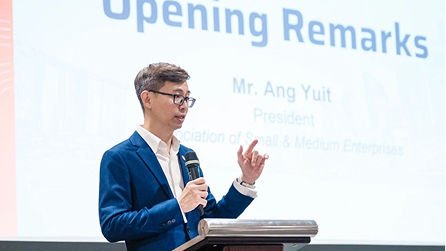


Keynote Address by Mr Ang Yuit, President, at Business Symposium 2026 on 22 May 2026
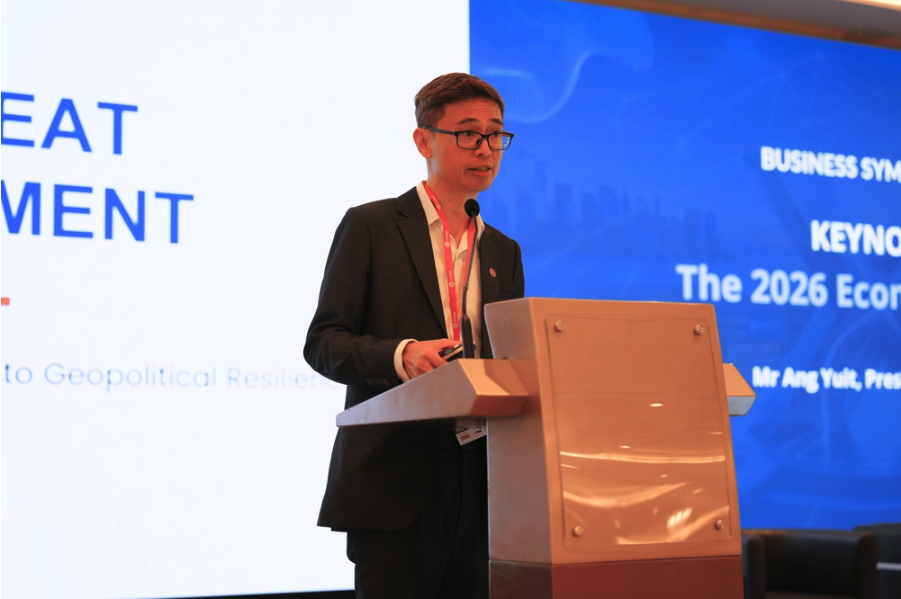
Good morning. This event marks a fresh start in our relationship with RWS. Hopefully, we have a lot more engagements here. Unlike previous engagements where we were tucked away in the basement main hall, we are now in this beautiful space filled with fresh air and sunlight.
It is my pleasure to welcome all of you here this morning to the Business Symposium 2026. This is ASME’s flagship event that gathers our resilient professionals, business leaders, and entrepreneurs.
The whole idea of today’s opening keynote is to talk about the landscape and economy. I will give some assessment around global trade and major trends so that we have a perspective on them. After the keynote, we will have various panels that will provide a breakdown and further details on these trends and directions that businesses should take advantage of. So as you listen and hear, have a feel about how it gauges against your own personal experiences, as well as have it as the context as you sit through the rest of the day.
So global trade has now reached $33 trillion. Of course, I think it has not been growing as fast as it used to over the last 5 years, but many of you will feel in your daily operations that the complexity of navigating it has never been higher – especially for those businesses that are dealing with international trade and cross-border. Between rising tariff hikes and ongoing political conflicts, the ground beneath all of us, not just businesses, is constantly shifting. And that is why, from the association perspective, our theme this year is “Architects of Ambition: Building Global Infrastructure”, and that centres around the importance of building a strong foundation that will not crack under global volatility.
Let me begin by looking at the map of the world that we live in. So we call it “The Great Realignment”, and in the time it took for us to convene this morning, millions of data points would have shifted and changed in the global trade balance, and we have transitioned from an era of lower efficiency where every country thought about how to make it more efficient in our transaction economy, in terms of trade and collaboration, to become what is termed now as “The Great Realignment”.
Therefore, the “Just-in-Time” model has given way to the “Just-in-Case” reliability. For the longest time, global trade was driven by “Just-in-Time” supply chains. If you think back a decade ago, all supply chains came in and the flow was very smooth, right? And that maximises the cost efficiency through big global integration. But today, we face a new reality.
Geopolitical uncertainty is on the rise with armed conflicts like the Iran War. And also, if you look at the environment side, it’s continuing to worsen, and we’re having challenges because certain segments of the world think that the environment should take a backseat. But us living in Asia, we know that the environment is important, and that’s why we are taking our own action.
A “Great AI Divide” is also happening – so you have companies and people who are the AI natives who are catching on to AI, and many others who are concerned and very worried that their jobs are taken away because of AI. And of course, you have the economic volatility – stock markets high and low. I think for people who have invested in DBS and in memory chips and semiconductors, that’s a good thing, but the overall volatility isn’t a good thing for us. And then we have the economics – trade flows are being reconfigured, and the established relationships that all of us are very familiar with are fragmented, and now it’s centred more around regional trade flows. And that’s why having good ties with ASEAN countries is important because we can then continue to retain resilience.
When the trade flows are reconfigurated, the impact is on us. As trade flows change, new and competitive ecosystems come in and outcompete the ecosystem that many of our businesses rely on. So if you have questions like – why is my business volume going down? Or why is it that my market doesn’t seem to be as robust? Chances are that the ecosystem that you rely on is not doing well, so that’s really important for many of us to understand, because some of the problems we deal with are not something that you see immediately, and you must sense and intuit what actually is the source of that challenge. So for us, because of the coming volatility, and then we have authoritarianism and populism, that changes a lot of the political stability globally. We then have to think about how we can take advantage of the “Just-in-Case” supply chains that have been configured, and where in your business you can locate yourself.
This is actually a very foundational part, and you all would have heard about this in the news, and it’s been happening in the past years. You have started to already see the post-US trade architecture – it started during the Trump 1.0 but people think that it was only a blip, and it was a rare outlier case, but then when Biden came on, the continued decoupling happened, and then it raised the post-US trade architecture so what we need to understand about this realignment is that the global trip is rewiring, and the rewiring is to bypass having United States at the centre, where the past that dealt was the crux of where all trade happened. So while the US effective average rates have reached their highest level since 1914, it’s also important to note that the US actually only accounts for 15% of the global trade. The other 85% of the world is largely continuing with a rules-based system we know, but by doing so, by taking partners more opportunistically.
I think it will move on from opportunistic selection to a more permanent selection over time, and it may take over the next five years. Singapore actually is very uniquely positioned to thrive with this 85%. So, by making our commitment to free trade and expanding our network of digital economic agreements, we actually act as a bridge between all these different fragmented blocks. And we’re seeing a 30% increase in regional trade agreements, and that is 375 active agreements in 2025 as nations seek security over simple cost savings. In this environment, being a trusted partner goes beyond just a diplomatic stance; it’s a competitive advantage that we, as SMEs, can start considering taking advantage of.
Being global no longer means being Western-centric, it means being agile enough to follow the capital where it’s actually growing. Expansion is no longer a linear path going from the east to the west or the west to the east. We are in an age of polycentric growth, so there are many centres. So if you look at the Gulf Asia trade region in 2024, the trade reached $560 billion, which is double the value of the Gulf to Western trade. Of course, with the Iran war, it’s taken a hit to the current conflict, but there will likely be a rebound once things settle down.
In Southeast Asia, in the beating heart of this shift, last year’s GDP was set to $4.3 trillion, with a projected 4.6% growth this year, driven by internal demand and massive influx of foreign direct investment. I think Malaysia is also a great beneficiary of this move, and we’re seeing the Ringgit getting very strong and really strengthening against the US dollar. Asia now dominates the manufacturing for chips in almost every electronic device. In fact, 33 of 40 largest chip corridors involve Asia alone. As DPM Gan emphasised in the 13 May Future Economic Conference, Singapore must remain as a vibrant hub that connects these corridors. For our SMEs, this means looking beyond traditional markets to these high-growth zones defined by digital readiness and regional integration.
To tap into these markets, SMEs need to scale fast as these markets require more than just a good product. It requires inorganic partnerships, and organic growth is usually a little slow for a fast-moving ASEAN market. So in the first panel this morning, we will dive into some of these facets around how we can accelerate our growth, not just by organic but inorganic ways, and ASME has a programme called SME UNITE, and I can talk a bit more about that. We want to explore mergers, acquisitions, consortiums, joint ventures and strategic alliances that will help you build the physical resilience amongst one another that will survive this volatile but high reward corridor.
Then of course, in the global trend, where the infrastructure supercycle, people who have shares in Micron and Sandisk will know this, right? This pro-growth is almost an effect, not just GDP, but by digital readiness. So we are currently in the AI infrastructure supercycle, and global spending on AI is reaching $2.5 trillion this year. So I think, personally, it’s not just a tech trend, it’s going to form the backbone of the new economic infrastructure. Human beings are going to be working side by side with AI and agentic tools and energetic workforce, and our future workforce will look very different as robots also come in together with AI embedded into them. In Singapore, our government is positioning Singapore as a living lab for AI solutions, and now we host over 26 AI centres of excellence, of which one of them is ASME@AITE. Those who have assimilated the use of the new technologies and AI will shape the global economy. Those who have not will likely fall behind further, unless you are in a very high touch sector. So there must be a focus on human infrastructure to ensure that our workforce is AI-bilingual and capable of blending their knowledge expertise with these new digital tools.
Simultaneously, the world is growing ever more conscious of the environment and social impact. With a growing focus on ESG, we find that success no longer is defined purely by profit. Today’s supply chain demands sustainability, talent demands purpose, and customers demand ethics. If you take a look at the recent Iran war, sustainability has now become the forefront, especially in areas of power generation and new energy, so as we gear towards certain trends, some of the moves where you can take advantage doesn’t happen gradually, it happened when the shock comes in, and then you find that you are positioned for it.The map has certainly started to turn green, with 20% of global greenfield FDI now flowing into renewables. As “Architects of Ambition,” we must position our SMEs within these “green corridors” where sustainability and growth coexist. This isn’t just about the environment; it’s about sustainable business models that can withstand regulatory scrutiny.
One in four global emissions is currently embedded in traded tools, goods like electronics and steel. By adopting ESG early, our SMEs won’t just be doing good, they’re also going to be securing their spot in the global supply chain that will eventually erode away those that are not compliant.
Earlier this year, we signed a partnership with WIPO, also known as the World Intellectual Property Organization, and we launched our first WIPO IP Business Centre at ASME. So, why did the association do this? The nature of business value has fundamentally shifted. In the 1970s, physical assets ruled. Today, intangibles and intellectual property represent over 90% of S&P 500, and your intellectual property is likely one of your vital advantages. We will dive deeper into this in another panel later.
Our Singaporean workforce is rapidly outpacing the region in cost by a very wide margin, and we are navigating a landscape where workforce expectations get higher and higher. We are navigating a landscape where workforce expectations are demanding talent and are also seeking a more sophisticated and holistic value proposition, not just in terms of benefit, but also in terms of well-being and professional development. Yet the enduring strength remains that in Singapore we are one of the best trained workforces in the region.
Beyond all the trends shared so far, there is a need to consider the resilience of our “Human Architecture”. However, we must be honest about the challenges we face on our home front. Our Singapore workforce is rapidly outpacing the region in cost by a wide margin, and we are navigating a landscape where workforce expectations have become higher and higher. We are navigating a landscape where workforce expectations are demanding, and talent is also seeking a more sophisticated and holistic value proposition, not just in terms of benefit, but also in terms of the well-being and professional environment.
But yet, the enduring strength remains that in Singapore, we are one of the best-trained workforces in the region. We must build on this strength and create resilience in our manpower by providing the regional and technology exposure that helps our workforce expand our horizons overseas. By empowering our people to lead, we ensure that Singaporean talent participates in the regional shift.
Earlier this year we submitted the budget recommendation to the government. The reality for many of us is as we see Singapore’s growth hitting a decent 3-4%, many of us are asking ourselves, why is it that we may not be seeing this. I think the challenge really is that the economy currently is growing at different pacing depending on which sector and which area we are in. So we call this the two speed economy, where there is an increasing gap between high performing firms and those that are struggling. One of the ways in which we can deal with this is really bridging the divide by cultivating AI bilingual talent – a critical bridge. For us in the SME space, where you have challenges finding manpower, I think AI bilingualism becomes one of the potential strategies we can use. So, what is AI bilingualism? If you listen to Min Josephine’s talk about it, it really describes individuals who can speak the dual language of business operations and strategy, as well as technology, in this case AI, and allows them to translate operational challenges into solutions. So, we published an AI work policy paper earlier this year, and you can go to our website and find out more about it.
However, our human capital strategy must go deeper than technical readiness. To remain competitive we must ensure our talent is retained. In the SME context, this is fundamentally about our human-centric approach. I think all of us here, or managers, know that we in the SME world care a lot more, or we have a much tighter relationship with our staff. Unlike the rigid regulated silos of larger corporations, SMEs actually offer a very unique sense of purpose and direct impact to employees when they are not just a cog in the wheel, right, or a big machine, but they are key contributors to a combined shared mission.
So from the perspective of SMEs that has a market and has kind of grown, I think we must keep in mind while we deal with the challenges, it’s not just about being concerned about the challenges we face and market and the people’s expectations, but it’s really about calling out to the best in our people and fostering a culture of strategic autonomy, where the talent has the freedom to innovate, and yet we are all aligned and headed in the same direction, and I think as we talk about going into the region and going to work, that would be a very good perspective to hand off and empower our staff to actually do to help drive our goal to expand our business in ways that we may not imagine possible.
So in this era of realignment, the SMEs that win will be those that can extract, can empower, can work with the workforce in such a way where they do not think of cost as something to be managed, but instead they are the foundation of the firm’s resilience and growth.
Now, as we look closer to home, we must also confront the Singapore Squeeze. Being a global Asian node is a very unique position, but it’s also a credit broker. Our market is increasingly squeezed as foreign competitors land on the shore, purely as a springboard to the region.
I think Singapore’s market is not large, so many firms that land on shore do not think about shores as a primary market, but yet Singapore is a very natural place for them to use as a springboard to the rest of Asia. So because of the influx from foreign countries, it inherently drives up the cost of our land, our labour and operations, and also, of course, market access.
This is a sign of our country’s success, but it’s also a challenge that we as a SME tend to take know of and be aware of. I shared earlier about ecosystem play, and many of these new firms that come in don’t just come in alone, they come in with an entire ecosystem and supply chain. Many of us have businesses that have services that service F&B, HR, Marketing, sales, accounting, when your primary customer goes away, then impact impacts you, your current customers in F&B food chain may be relying on logistics suppliers and food suppliers.
As SMEs, we have to start to implement and sense where the ecosystem is going, when your primary market may be evolving, and I think it’s really important for us to be very aware of that.
So the Singapore SME Response Playbook – in this environment, there are a few trends that we can take advantage of and leverage on the region for cost efficiency. Just across the causeway there is the Johor-Singapore Special Economic Zone. Many media ask me about the SEZ, but the reality is that the SEZ itself doesn’t have anything much for SMEs. Johor as a region is an area that you can consider going over to cost average staff, whether you are looking for land, manpower, or even potentially market. I’ve spoken to people who say that they hardly earn a profit in the retail sector in Singapore, but they can make money in JB, not that the footfall is higher, but the cost of rental and manpower is all lower in JB. So that becomes a question that we must really consider as we seek to take advantage of the current situation that we are in. Beyond JB, there is the Batam-Bintan Growth Triangle. I’ve been to Bintan and Batam and I was quite amazed at how fast it has progressed. Of course, for the Batam-Bintan Growth Triangle, I think it’s more for manufacturing industries. And beyond these countries there are Cambodia, Thailand and Philippines as well.
A second area we should look at is really polycentric growth. Singapore SMEs can act as the essential link between fragmented trading blocs. A lot of Chinese companies, European companies, and Japanese companies are thinking of coming to Singapore to take advantage of the new trade flows. SMEs can be in a position to take advantage of that if we know and open our eyes and be aware of the trend that’s happening, and we can position ourselves to leverage on this macro trend that’s happening.
Lastly, we should venture into new growth industries such as food, renewable energy, space, and deep tech. As we find the existing market worsening and disappearing for some of our businesses, I think it’s very natural that we should be looking at new markets, and there are certain markets that are going to be very crucial for the world in the next two decades. And if you are thinking and positioning your business for that kind of future, then it may be time to consider expanding or pivoting or exploring into these new markets and sectors.
So we are living in the age of the great realignment, where old rules of efficiency first and globalisation are over, and it’s replaced by a security-first regional approach.
The defining crises of our era – the environmental, geopolitical, and technological issues do not just explode overnight, they actually accumulate over time, and then it’s accelerated by certain events that trigger a cascade. So catastrophe, if you think about it, is not something that happens in a single moment, it’s a system that we can choose to re-engineer and be a part of. And understand that companies that position themselves correctly will take advantage when the cascade happens. So, as we move through today’s session, keep in mind my question: Are you building yourself for yesterday’s efficiency, or tomorrow’s opportunity and resilience? If we manage our growth strategically in this era, it will not be remembered for it being a catastrophe, it will be remembered as the moment that we choose transformation over decline.
Thank you.
ADVERTISEMENT